
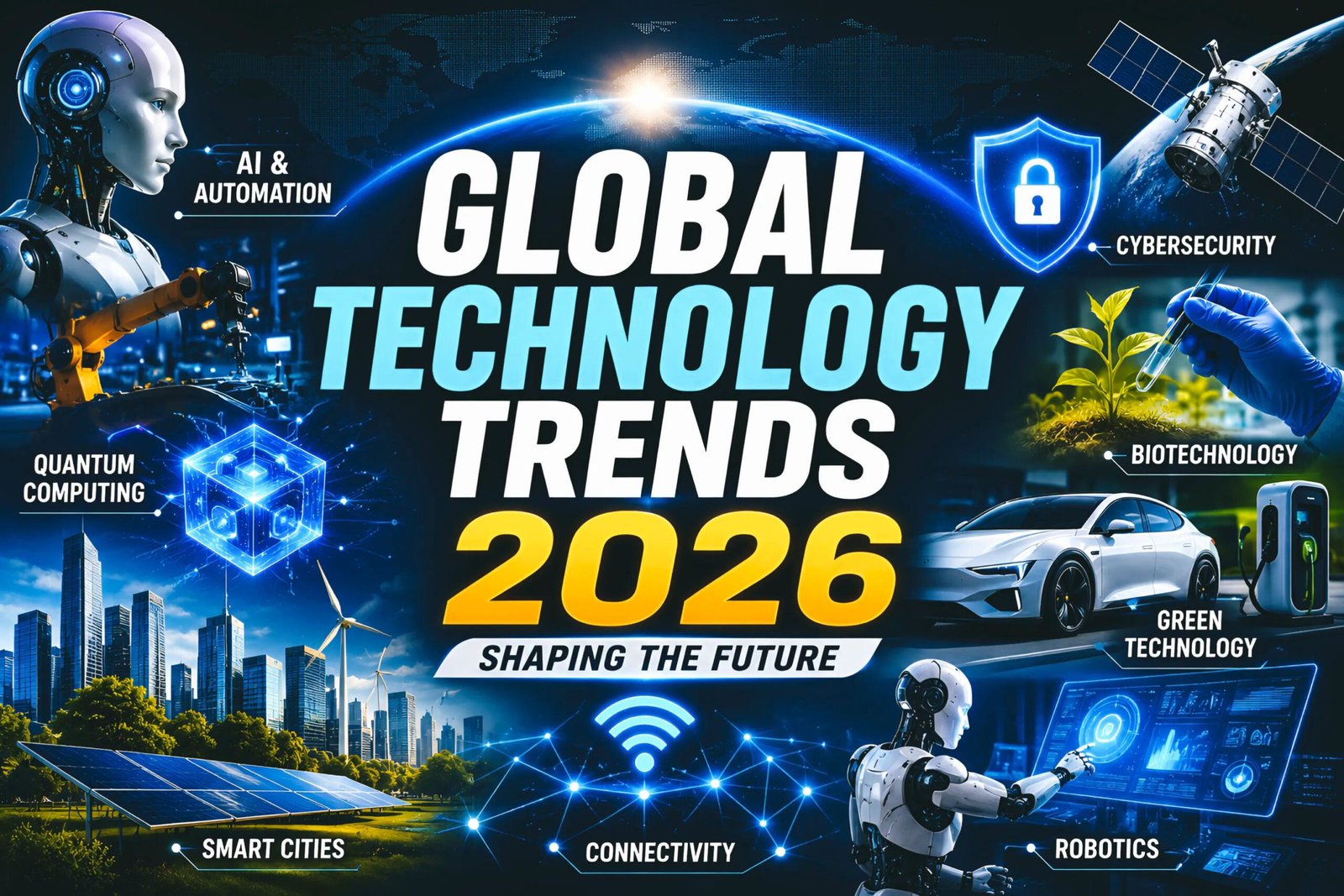
Technology has become the driving force behind economic growth, global security, education, healthcare, and communication. In 2026, countries are investing heavily in advanced technologies to improve productivity, strengthen cybersecurity, and accelerate digital transformation. Artificial intelligence remains a major innovation, but several other technologies—including quantum computing, robotics, semiconductor manufacturing, space technology, green energy, biotechnology, and next-generation communication—are rapidly transforming industries worldwide.
Governments and private companies are competing to develop faster, smarter, and more secure technologies. At the same time, concerns about privacy, misinformation, cybercrime, environmental sustainability, and ethical use of technology continue to grow. This article explores the most important global technology trends shaping the future and examines their impact on businesses, governments, and society.
1. The Rise of Intelligent Automation
Automation has evolved beyond simple manufacturing machines. Modern intelligent automation combines machine learning, robotics, cloud computing, and advanced sensors to perform complex tasks with minimal human intervention.
Industries such as logistics, banking, healthcare, retail, and manufacturing increasingly rely on automated systems to reduce costs, improve efficiency, and enhance customer experiences.
Key benefits include:
* Faster operations
* Reduced operational costs
* Higher productivity
* Improved workplace safety
* Better decision-making through data analysis
However, workforce transformation remains a challenge. Employees must continuously upgrade their digital skills to adapt to rapidly changing technologies.
2. Quantum Computing: The Next Computing Revolution
Quantum computing is emerging as one of the most significant technological breakthroughs of the decade. Unlike traditional computers that process information using binary bits, quantum computers use quantum bits (qubits), enabling them to solve certain highly complex problems much faster.
Potential applications include:
* Drug discovery
* Climate modeling
* Financial risk analysis
* Material science
* Space research
* Logistics optimization
Although commercial quantum computing is still developing, governments and technology companies continue investing billions of dollars in research.
3. Semiconductor Industry Expansion
Semiconductors are the foundation of every digital device, from smartphones to satellites.
Global demand for advanced chips has encouraged many countries to expand domestic semiconductor manufacturing.
Major investment areas include:
* Advanced chip fabrication
* AI processors
* Automotive electronics
* High-performance computing
* Data centers
* Consumer electronics
Building secure semiconductor supply chains has become a strategic national priority for many economies.
4. Cybersecurity in the Digital Age
As digital transformation accelerates, cyber threats have become increasingly sophisticated.
Organizations face challenges such as:
* Data breaches
* Identity theft
* Ransomware attacks
* Financial fraud
* Supply-chain attacks
* Cloud security vulnerabilities
Businesses now prioritize:
* Multi-factor authentication
* Zero-trust security
* Endpoint protection
* Threat intelligence
* Security awareness training
Cybersecurity has evolved into one of the fastest-growing sectors within the global technology industry.
5. Green Technology and Sustainable Innovation
Technology is playing a major role in addressing climate change.
Countries are investing in:
* Renewable energy
* Smart electrical grids
* Electric vehicles
* Hydrogen energy
* Battery technology
* Carbon capture systems
Smart energy management systems use sensors and digital analytics to improve energy efficiency while reducing environmental impact.
Green technology is expected to create millions of new jobs over the coming decade.
6. Robotics Across Industries
Modern robots are no longer limited to factory production lines.
Robotics applications now include:
* Healthcare surgery
* Warehouse automation
* Agriculture
* Construction
* Hospitality
* Disaster response
Collaborative robots (co-bots) work alongside humans, increasing productivity while reducing workplace injuries.
Advanced robotic systems continue becoming more affordable and capable.
7. Digital Healthcare Transformation
Healthcare technology is improving patient care worldwide.
Recent innovations include:
* Telemedicine
* Remote patient monitoring
* Wearable health devices
* Electronic medical records
* AI-assisted diagnostics
* Precision medicine
Digital healthcare helps doctors monitor patients remotely while improving access to medical services in rural and underserved regions.
8. Space Technology Enters a New Era
Space exploration is expanding beyond government agencies.
Private companies are investing in:
* Satellite internet
* Reusable rockets
* Lunar exploration
* Deep-space missions
* Earth observation
* Space tourism
Satellite technology supports agriculture, navigation, disaster management, environmental monitoring, and global communications.
The commercial space economy is expected to continue growing rapidly.
9. Smart Cities and Digital Infrastructure
Cities worldwide are adopting intelligent technologies to improve urban living.
Smart city initiatives focus on:
* Intelligent traffic systems
* Digital public services
* Smart lighting
* Water management
* Waste management
* Environmental monitoring
Internet-connected sensors enable governments to collect real-time data for more efficient city planning.
10. Future of Communication Networks
Next-generation communication technologies continue expanding.
Developments include:
* Faster mobile connectivity
* Satellite broadband
* Private enterprise networks
* Edge computing
* Internet of Things connectivity
High-speed communication networks support autonomous vehicles, industrial automation, smart healthcare, and remote education.
11. Biotechnology Innovation
Biotechnology continues transforming agriculture and healthcare.
Major research areas include:
* Gene editing
* Personalized medicine
* Disease prevention
* Agricultural biotechnology
* Bio-manufacturing
* Vaccine development
These innovations aim to improve food security while advancing global public health.
12. Digital Education Revolution
Education has become increasingly technology-driven.
Educational institutions now utilize:
* Virtual classrooms
* Interactive learning platforms
* Digital assessments
* Cloud collaboration
* Educational analytics
* Personalized learning systems
Technology helps expand access to quality education regardless of geographical location.
13. Challenges Facing the Technology Sector
Despite rapid innovation, significant challenges remain.
Key concerns include:
* Digital inequality
* Privacy protection
* Ethical use of technology
* Cybercrime
* Misinformation
* Energy consumption of large computing systems
* Regulatory compliance
* Workforce res-killing
Addressing these challenges requires cooperation between governments, technology companies, researchers, and educational institutions.
14. Opportunities for Businesses
Businesses embracing digital innovation can benefit from:
* Improved operational efficiency
* Better customer engagement
* Faster product development
* Reduced costs
* Enhanced competitiveness
* Global market expansion
Successful organizations increasingly invest in digital transformation strategies while strengthening cybersecurity and workforce training.
15. What the Future Holds
Technology will continue shaping every aspect of modern life. Future innovations are expected to focus on human-centered design, sustainable development, secure digital infrastructure, and responsible innovation.
Global collaboration will remain essential for addressing challenges such as climate change, cybersecurity, healthcare accessibility, and digital inclusion.
Countries investing in education, research, infrastructure, and innovation ecosystems are likely to become leaders in the next generation of technological development.
The global technology landscape in 2026 reflects an era of rapid transformation. Advances in quantum computing, robotics, cybersecurity, biotechnology, semiconductor manufacturing, green technology, smart infrastructure, and digital healthcare are redefining economies and societies around the world.
While these innovations offer remarkable opportunities, they also introduce complex ethical, regulatory, and security challenges. Governments, businesses, researchers, and citizens must work together to ensure technology remains secure, sustainable, and beneficial for all.
The future belongs not only to those who invent new technologies but also to those who adopt them responsibly, build resilient digital ecosystems, and prioritize innovation that improves quality of life. As technological progress accelerates, the world is entering a new chapter where digital transformation will influence nearly every industry, every economy, and every individual.

